Swim Jets
Inside a Swim Jet: The Engineering Behind an Endless Current
February 10, 2026 · 6 min read
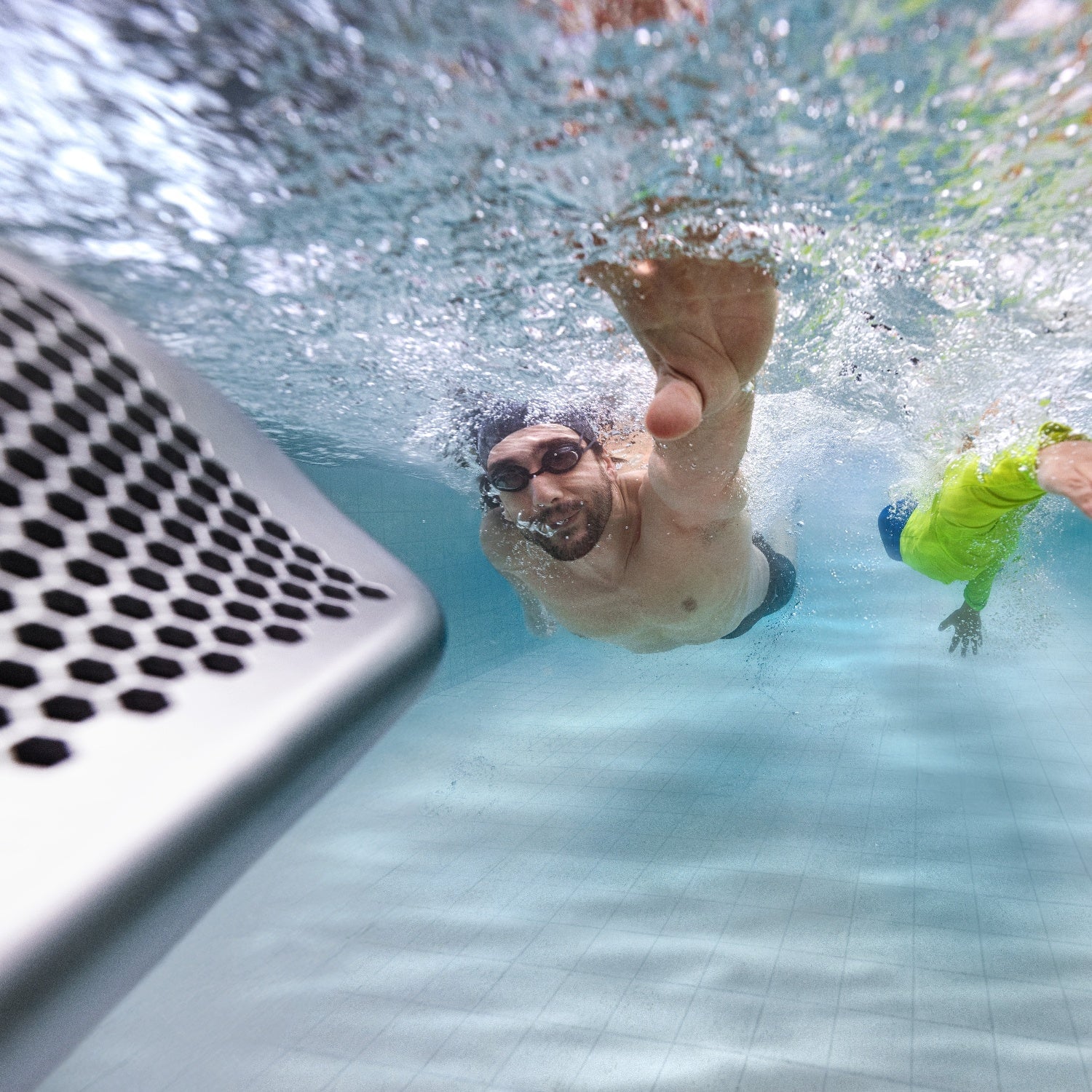
Anyone who has stood in front of a weak pool jet knows it doesn't feel like swimming - it feels like fighting a narrow, bubbly stream. A proper swim jet feels completely different: a broad, smooth wall of water you can swim into for an hour. That difference is entirely about engineering, and it comes down to three things working together.
Move a lot of water - smoothly, not just fast
The instinct is to make the jet faster, but speed alone creates a thin, turbulent stream that's unpleasant to swim against. What you actually want is volume: a large mass of water moving at a swimmable pace. The M Series is built around that idea, with the M230 pushing 230 m³/h - a genuine river of water rather than a pressure-washer spray.
The motor and inverter control
Driving that volume quietly and efficiently takes a strong, well-controlled motor. A PMSM (permanent-magnet) motor paired with full-inverter control lets the system run smoothly and tune the flow continuously - from a gentle float right up to a race-pace current - without the noise or harsh on/off steps of a basic pump. Continuous control is also what makes the five swim modes feel distinct rather than gimmicky.
Flow channel and nozzle shape
The last piece is the part you never see: the flow channel and nozzle that shape the water before it reaches you. A precisely formed channel widens and smooths the output into a broad, fan-shaped current that covers more of your stroke, so you're not threading a single narrow jet. That's the difference between water that buffets you and water you can settle into.
Put the three together - high volume, smooth inverter-controlled power and a shaped, wide output - and the result feels less like a garden hose and more like the open ocean: a steady current you can train against, hour after hour.
Frequently Asked Questions
- What makes a swim jet feel different from a spa jet? +
- A spa jet creates a narrow, localised blast for massage. A swim jet moves a large volume of water at a swimmable pace through a shaped outlet, producing a broad, smooth current you can swim against for extended periods.
- What is a PMSM motor and why does it matter in a swim jet? +
- PMSM stands for permanent-magnet synchronous motor. It delivers smooth, efficient power with continuous speed control, allowing the M Series to transition between gentle and strong currents without the noise or harsh steps of a basic pump.
- Why does water volume matter more than jet speed? +
- Speed alone creates a thin, turbulent stream that is unpleasant to swim against. Volume moves a large mass of water at a comfortable pace. The M230 pushes 230 m³/h to create a genuine wall of water rather than a narrow blast.
- How does the nozzle shape affect the swimming experience? +
- A precisely formed flow channel widens and smooths the output into a broad, fan-shaped current. This covers more of your stroke so you are not threading a single narrow jet, making it easier to hold a natural body position.
- What are the five swim modes on the M Series? +
- The M Series offers five distinct modes that range from a gentle current for relaxation or water walking through to a strong training pace. Each mode provides a different intensity level so users of varying fitness can find a suitable setting.
- How is the M Series controlled? +
- You can adjust the current using the built-in touchscreen, a Bluetooth remote control, or the companion app. This makes it simple to change speed during interval sessions or switch between family members without leaving the water.
- Is the 12V power supply safe around water? +
- Yes. Both the M180 and M230 operate at 12V, which is classified as extra-low voltage. This is significantly safer around water than mains-voltage equipment and is one of the key safety features of the M Series design.
- What is the difference between the M180 and M230 current? +
- The M180 produces 180 m³/h flow at up to 3.3 m/s, suitable for recreational to moderate fitness swimming. The M230 produces 230 m³/h at up to 4.0 m/s, providing a stronger current for more advanced training.
- How quiet is a swim jet compared to a pool pump? +
- The M Series uses a PMSM motor with full inverter control, which runs more quietly and smoothly than traditional single-speed pumps. The absence of harsh on/off steps also reduces noise during operation.
- Can turbulence in the water affect my swimming technique? +
- Yes. Excessive turbulence from a poorly designed jet can push you sideways and force constant correction. The M Series uses a shaped flow channel to create a stable, coherent current that supports natural body position and stroke mechanics.
Ready to upgrade your pool?
Explore the Swim Jets Australia range or get a tailored recommendation in two questions.